
From JD Faccinetti – Cofounder chief editor PWN and AWN – One of the most valuable things you can do to help the pituitary community is share your own experience. What you have lived through helps others understand the realities of living with acromegaly, or any other disease. It helps clinicians see challenges that never show up in a lab result and helps make sure that programs and services are built on patients needs. Taking part in research and using your voice is one of the most direct ways to do that.
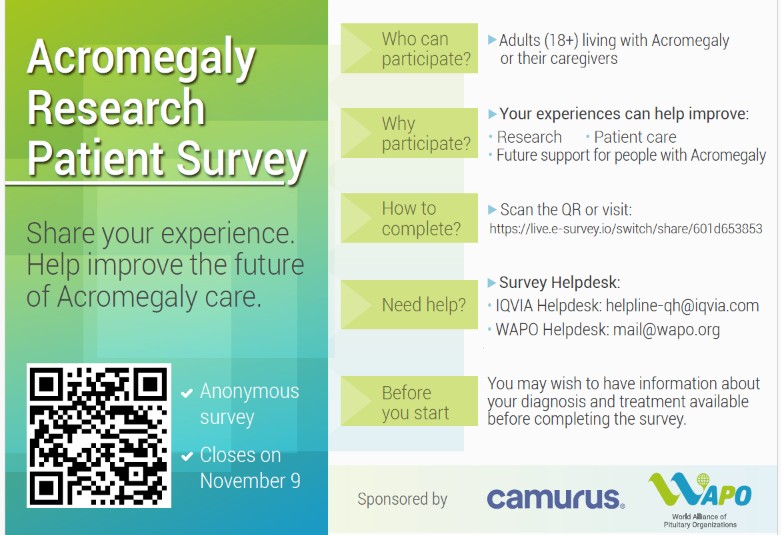 The World Adrenal and Pituitary Organizations (WAPO) recently launched a global survey of people living with acromegaly to do just that. It asks about diagnosis, treatment, day-to-day care, and the emotional and social impact of living with the disease. We applaud the effort and encourage you to take part. Even thought acromegaly patient research has been extensive and comprehensive in the US and Europe, far too little is known about how patients around the world experience acromegaly, particularly in the areas of real need, and any serious attempt to capture their voices deserves our support.
A few caveats
We would be doing our readers a disservice if we didn’t also point out that online patient surveys like this one have very real limits. That doesn’t make the effort less worthwhile. It means the results should be read with caution and care, and that they are a starting point rather than the final word.
- Who answers can drastically shape the information. Surveys shared through patient groups and social media tend to reach people who are already connected, engaged, and comfortable online. People who are struggling on their own, who have given up on the health system, who are older, or who live where care and internet access are scarce are much harder to reach, and their experiences may look very different.
- A single survey captures how people are doing at one moment in time, not how their experience changes over years of diagnosis, treatment, and recovery or how it has progresses over the years. It’s a snapshot, a point in time.
- Memory plays a key role. Questions about how long diagnosis took, past treatments, or test results rely on recall, which is imperfect, especially for events that happened years ago.
- Global comparisons are tricky. Health systems, available treatments, and even how a question is understood vary from country to country. A single global average can hide important differences.
- Connections aren’t causes. A survey can show that two things tend to go together, such as missed appointments and depression, but it can’t tell us which one drives the other.
More information is better than no information, as long as we are clear about what that information can and can’t tell us. We hope WAPO will publish its methods and their limitations alongside the findings. We also hope the survey becomes a first step toward deeper work: in-depth conversations with patients, follow-up over time, and partnerships with local organizations that can reach the people a global online survey is likely to miss.
How to make your voice count
- Use the open-ended questions. The comment boxes are often where the most valuable insights come from. Say it in your own words.
- Be clear about who is answering. If you are filling it out on behalf of a family member, say so. Caregivers see things patients don’t, and vice versa, and researchers need to know which is which.
- Share the link to the survey. Send it to people who aren’t active in support groups or online communities if you can. Their experiences are the ones most likely to be missing. We believe the vast majority of people do not engage with patient groups.
To take part, visit the SURVEY LINK here, or scan the QR code on the information flyer on this article. The survey is open until November 9.
© 2026, J D Faccinetti. All rights reserved.